The HEC USAT is one shared entry test that a long list of public and private universities in Pakistan accept for BS admissions — clear it once and you can use the score at many universities, and for HEC’s own undergraduate scholarship schemes too. Here is the whole process: registration, the fee, eligibility, the six test categories and the paper pattern.
The last USAT sitting of 2026 was announced on 8 November 2026. Registration closes on Tuesday, 24 November 2026 (extended from Sunday, 22 November 2026), the test is on Sunday, 13 December 2026, and the result is due on Thursday, 31 December 2026. The test fee is Rs 1,200, as reported for the 2026 sittings. If you are planning BS admission for 2027, this is the sitting to catch — there is no sixth sitting in 2026.
That is the situation most intermediate students are in right now — and if you are one of them, this guide covers HEC USAT 2026 apply online from start to finish. You finish FSc, FA, ICS or A-levels, and suddenly every university wants an entry test score. Some want their own test, like NUST’s NET or UET’s ECAT. But a long list of public and private universities across Pakistan accept one shared test instead — the HEC USAT. Clear it once, and you can use the score for BS admissions in many universities, and for HEC’s own undergraduate scholarship schemes too.
The good news is that the last USAT sitting of 2026 is open for registration right now. The Higher Education Commission announced it on 8 November 2026, and the portal stays open until Tuesday, 24 November 2026 (extended from Sunday, 22 November 2026). The test itself is on Sunday, 13 December 2026. If you are planning BS admission for 2027, this is the sitting to catch — there is no sixth sitting in 2026.
I have put this guide together from HEC’s own documents: the Education Testing Council’s Test Calendar for 2026, its USAT content weightages paper, and its FAQ page. Where HEC itself does not publish a figure, I say so plainly instead of guessing.
Last verified: 24 November 2026 — the last date was re-checked against the ETC portal today; the other dates and links were checked against the official sources below.
Update: HEC extended the registration last date to Tuesday, 24 November 2026 (from Sunday, 22 November 2026). HEC announced the extension on 23 November 2026, and the ETC portal (etc.hec.gov.pk) shows 24 November 2026 as the last date. HEC’s published Test Calendar image (revised 25 August 2026) still shows 22 November — it has not been updated yet. The test date (13 December 2026), roll number slip date (4 December 2026) and result date (31 December 2026) are unchanged.
HEC USAT 2026 at a Glance
| Test | Undergraduate Studies Admission Test (USAT) |
| Conducted by | Higher Education Commission (HEC), through the Education Testing Council (ETC) |
| Registration announced | Sunday, 8 November 2026 |
| Last date to apply online | Tuesday, 24 November 2026 |
| Roll number slip | Friday, 4 December 2026 |
| Test date | Sunday, 13 December 2026 |
| Result announced | Thursday, 31 December 2026 |
| Registration portal | https://etc.hec.gov.pk |
| Test fee | Rs 1,200 (reported for the 2026 sittings — confirm on the portal when you apply) |
| Total marks | 100 (75 MCQs + 25 marks essay) |
| Qualifying score | 50 out of 100 (reported — not published on HEC’s public pages) |
| Test categories | 6 — USAT-E, USAT-M, USAT-A, USAT-CS, USAT-GS, USAT-COM |
What Is the HEC USAT, and Who Actually Needs It?
USAT stands for Undergraduate Studies Admission Test. HEC introduced it as one standard entry test for undergraduate admissions, built on the pattern of the international SAT. Instead of every university running its own test for every BS programme, the Education Testing Council runs USAT four to five times a year in major cities across Pakistan, and participating universities use the score in their merit formulas.
You need USAT if you are applying to a BS programme at a university that asks for it. That includes many public-sector universities — Quaid-i-Azam University, for example, used USAT for its Fall 2026 admissions — and a growing list of private universities recognised by HEC. Each university publishes its own merit formula, so USAT is one part of the merit, not the whole of it. Your FSc or FA marks still count.
The second reason to sit USAT is scholarships. HEC’s undergraduate scholarship schemes also consider the USAT score, so a good score does double duty: admission and financial aid. That is why teachers push students to take it even when their first-choice university has its own test. A USAT score in hand is a safety net. If your first choice does not work out, you still have a valid score for other universities.
One thing USAT is not: it is not a replacement for every entry test. NUST still runs NET for its own admissions, UET still runs its own entry test, and medical colleges still need MDCAT. USAT sits alongside those. If you are aiming for engineering at NUST, read our guide on NUST NET 2027 registration as well. If you are looking at the big picture of BS admissions across public universities, our BS admission 2026 guide for Pakistan’s public universities explains how the different tests fit together.
HEC USAT 2026 Important Dates — The Full Cycle
HEC’s Education Testing Council publishes one test calendar for the whole year, revised on 25 August 2026. The December sitting is the fifth and last USAT of 2026. Here is the complete cycle — with one update: HEC extended the last date from 22 November to 24 November 2026 (announced 23 November 2026; the ETC portal shows 24 November 2026). The calendar image itself still shows 22 November.
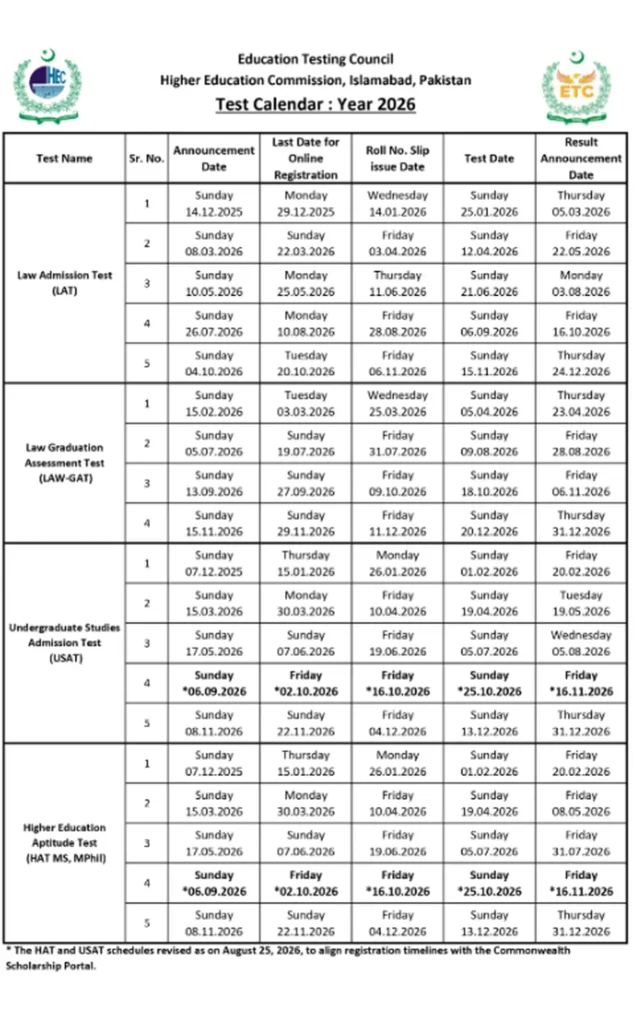
| Stage | Date |
|---|---|
| Announcement | Sunday, 8 November 2026 |
| Last date for online registration | Tuesday, 24 November 2026 |
| Roll number slip issued | Friday, 4 December 2026 |
| Test date | Sunday, 13 December 2026 |
| Result announced | Thursday, 31 December 2026 |
Two things about these dates matter. First, the earlier sittings of 2026 are already done — the fourth sitting was held on 25 October 2026, and its result is due on 16 November 2026. If you sat that one and the result disappoints you, this December sitting is your second chance in the same year. Second, HEC’s calendar gives no sixth sitting in 2026. Miss 24 November, and the next USAT will be in 2027, on dates HEC has not announced yet.
A small note for HAT candidates: the Higher Education Aptitude Test (HAT) for MS and MPhil admissions runs on the same cycle. Its fifth sitting also opens on 8 November, closes on 24 November (extended from 22 November), and is tested on 13 December 2026, with the result on 31 December 2026. Same portal, same dates — but HAT is a different test for postgraduate admissions, not this one. See our guide to the HEC HAT Test 2026.
Who Can Apply — USAT Eligibility 2026
HEC has kept eligibility simple. You can register for USAT 2026 if:
- You have passed your Higher Secondary School Certificate (HSSC) — FSc, FA, ICS, I.Com — or an equivalent 12-year qualification such as A-levels, from a recognised board or institution.
- Or you are still waiting for your result. Students who have appeared in their final HSSC Part-II exams and are awaiting the result can register and sit the test. You do not have to wait for the result card.
There is no separate age limit published for USAT. Candidates below 18 register with their NADRA Juvenile Card or B-Form number instead of a CNIC, and on test day they bring the original B-Form plus their Matric or Intermediate result card carrying their photograph.
One rule HEC repeats in its FAQ, and it is worth repeating here: register with your own CNIC or B-Form number. Candidates who register using a parent’s, sibling’s or relative’s CNIC are not allowed to appear in the test, even if the fee is paid. A single wrong digit in the CNIC is enough to be turned away at the centre.
The Six USAT Categories — Pick the Right One
USAT is not one paper for everyone. It runs in six categories, matched to your intermediate stream. You choose one category when you register, and you cannot change it after submission — HEC’s FAQ is explicit about that. Pick the category that matches your FSc/FA background and the BS programme you want.
| Category | Stream | BS programmes it fits |
|---|---|---|
| USAT-E | Pre-Engineering | BSc/BE Electrical, Mechanical, Civil, Chemical Engineering |
| USAT-M | Pre-Medical | Pharm-D, BS Biotechnology, Microbiology, Allied Health Sciences |
| USAT-A | Arts & Humanities | BS English, Media Studies, IR, Psychology, Social Sciences, LLB |
| USAT-CS | Computer Science | BS Computer Science, Software Engineering, IT, AI, Data Science |
| USAT-GS | General Science | BS Mathematics, Statistics, Economics, Actuarial Sciences |
| USAT-COM | Commerce | BBA, BS Accounting & Finance, Commerce, Banking |
If you did FSc pre-medical and want Pharm-D or an allied health degree, that is USAT-M. If you did ICS and want software engineering, that is USAT-CS. If you did FA and want a BBA, that is USAT-COM. The common mistake is picking the category for the programme you wish you had studied, instead of the one that matches your intermediate subjects. The subject-specific section of the paper is built on your stream’s subjects, so the wrong category means answering questions on subjects you never studied.
USAT Test Pattern 2026 — Marks Distribution

This is taken from HEC’s own USAT content weightages document, which lists the exact split for all six categories. The test carries 100 marks and runs in two parts.
Part I — 75 MCQs, 100 minutes
Part I is the same in structure for all six categories. Only the 30 subject-specific questions change.
A. Verbal Reasoning — 20 MCQs
- Analogy — 5
- Synonym / Antonym — 4
- Sentence Completion — 6
- Reading Comprehension — 5
B. Quantitative Reasoning — 25 MCQs
- Arithmetic — 6
- Algebra and Functions — 4
- Geometry — 3
- Equations — 3
- Statistics — 3
- Scenario-based / Mental Mathematics — 6
C. Subject-Specific — 30 MCQs (depends on your category)
- USAT-E: Physics 10, Chemistry 10, Mathematics 10
- USAT-M: Biology 14, Chemistry 8, Physics 8
- USAT-CS: Computer Science 14, Mathematics 8, Physics 8
- USAT-COM: Accounting 10, Commerce 10, Economics 10
- USAT-GS: Mathematics 10, Statistics 10, Economics 10
- USAT-A: Islamiat / Ethics 10, Pakistan Studies 10, General Knowledge 10
Part II — Essay Writing, 40 minutes, 25 marks
- Argument-based essay — 15 marks: write on 1 out of 3 given topics.
- Narrative essay — 10 marks: write on 1 out of 3 given prompts.
- You can write both essays in English or Urdu — your choice.
What jumps out here is the balance of the paper. First, the essay is a full quarter of the paper. Students who spend all their preparation on MCQs and ignore the essay hand over 25 marks. Second, there is no negative marking mentioned in HEC’s pattern — but do not take that as a reason to guess wildly; a wrong answer still earns nothing, and your time is better spent on questions you can solve.
The qualifying score is 50 out of 100 (reported). That is the pass mark reported for USAT. But remember that universities set their own merit cut-offs, and a bare 50 rarely wins a seat in a competitive programme. Aim for 70 or above if you want the score to actually open doors.
HEC USAT 2026 Apply Online — Step by Step
Registration is online only, on the HEC Education Testing Council portal. There is no paper form and no bank challan form to collect. Follow these steps exactly.
Step 1 — Open the ETC portal. Go to https://etc.hec.gov.pk. This is the only official portal. HEC has warned about fake sites copying its portals, so type the address yourself instead of clicking links from random posts.
Step 2 — Create your account. Sign up with your own valid CNIC number. If you are below 18, use your NADRA Juvenile Card or B-Form number. Enter your name exactly as it appears on your Matric certificate — the portal asks for title, first name, middle name and last name. Upload a recent passport-size photograph with a blue or white background. Give an active email address and a mobile number that has not been ported from one network to another, because SMS alerts and roll number slip notifications go to that number. Once you save your profile, it locks — no further changes are allowed. Check every detail before saving.
Step 3 — Select the test and your category. Log in to your ETC profile. The latest available test link appears on your dashboard. Click it, choose USAT, then pick your category (E, M, A, CS, GS or COM) and your preferred test city. Tests are held in major cities across Pakistan. Once selected, the test city cannot be changed.
Step 4 — Pay the fee. Generate your consumer number by clicking the “Online Payment” button under the “My Application” section. Pay through any 1Link / 1Bill channel — a bank branch, ATM, internet banking, a mobile banking app, JazzCash, Easypaisa or UPaisa. The fee reported for the 2026 sittings is Rs 1,200, and it is non-refundable and non-transferable. HEC shows the exact fee on the portal when you apply, so if the portal shows a different figure, the portal is final. Keep your payment proof safe.
Step 5 — Verify the payment and submit. This is the step people forget, and it costs them their application. After paying, log back into your ETC dashboard and click “Verify Online Payment”. Then click Submit. Your application status must change to “Submitted”. Applications left in Save or Incomplete mode are not entertained. Check the status yourself — do not assume the payment went through.
Step 6 — Download your roll number slip. Slips for this sitting are issued on Friday, 4 December 2026. Log in to the portal and print yours. Without the printed slip, you cannot enter the test centre.
If anything goes wrong — the consumer number does not generate, the payment does not verify, the portal throws an error — lodge a complaint at HEC’s online helpdesk, https://onlinehelp.hec.gov.pk, or call ETC at 051-90408184. Do it at least three days before the deadline. HEC’s FAQ says complaints submitted on the last day will not be entertained.
USAT Fee 2026
The test fee reported for the 2026 USAT sittings is Rs 1,200, paid through 1Link / 1Bill. I could not confirm the amount on an HEC page itself — HEC’s FAQ confirms the payment method (consumer number through 1Link/1Bill) but does not print the amount, and the ETC portal shows the fee only after you log in and select the test. Several current guides for the 2026 sittings quote Rs 1,200. One older page quotes Rs 2,000, but that page also carries outdated dates from earlier in the year, so I am not relying on it. Treat Rs 1,200 as reported, and confirm the exact figure on the portal before you pay.
What to Bring on Test Day — 13 December 2026
HEC’s FAQ lists the test-day rules plainly. Print this part and check it off the night before.
- A printed copy of your roll number slip.
- Your original valid CNIC or passport (18 and above). Photocopies and phone photos of ID are not accepted.
- Under 18: your original B-Form and your original Matric or Intermediate result card bearing your photograph.
- A transparent clipboard and black or blue ball pens for the OMR sheet. Lead pencils, fountain pens and markers are not allowed.
- Leave these at home: mobile phones, smart watches, calculators, earbuds, vapes and any other electronic gadget. Anything found on you is confiscated, and an unfair-means case is registered.
If you have lost your CNIC, you need three things: the police report about the loss, the NADRA receipt showing you have applied for a new CNIC, and your original Matric or Intermediate certificate or result card with your photograph.
Also note the juvenile-card notice on HEC’s announcements page: candidates below 18 who do not have a Juvenile Card should get one from NADRA before the test date, because it must be shown for entry to the centre.
When your roll number slip arrives on 4 December — check these five things
Registration for this sitting was announced on 8 November 2026 and closes on Tuesday, 24 November 2026 (extended from Sunday, 22 November 2026). Roll number slips are issued on Friday, 4 December 2026, the test is on Sunday, 13 December 2026, and the result is announced on Thursday, 31 December 2026. When your slip is ready, log in to the ETC portal at https://etc.hec.gov.pk, download it and print it — without the printed slip, you cannot enter the test centre. Then check these five things before you put it away.
- Your name. It should match your Matric certificate exactly, including the spelling. A wrong spelling on the slip can cause problems at the gate.
- Your CNIC or B-Form number. It must be the number you registered with — your own, not a parent’s or sibling’s. Candidates who registered using someone else’s CNIC are not allowed to appear in the test, even if the fee is paid.
- Your category. Check that the slip shows the category you chose — E, M, A, CS, GS or COM. The category cannot be changed after submission, so if it is wrong, you need to know now, not on test day.
- Your test city and centre. The test city cannot be changed after registration. Work out how you will get to the centre on 13 December now — the route, the travel time, and who is taking you — instead of sorting it out on the morning of the test.
- The reporting time for your centre. Check the slip and the ETC portal for the time you must report, and plan around it. Arriving late to a test centre is not something you can fix once the paper has started.
If anything on the slip is wrong, raise it at HEC’s online helpdesk, https://onlinehelp.hec.gov.pk, or call ETC at 051-90408184 — and do it straight away, while there are still nine days before the test. Print a second copy of the slip and keep it at home, separate from the one in your bag.
How to Prepare — A Realistic Plan
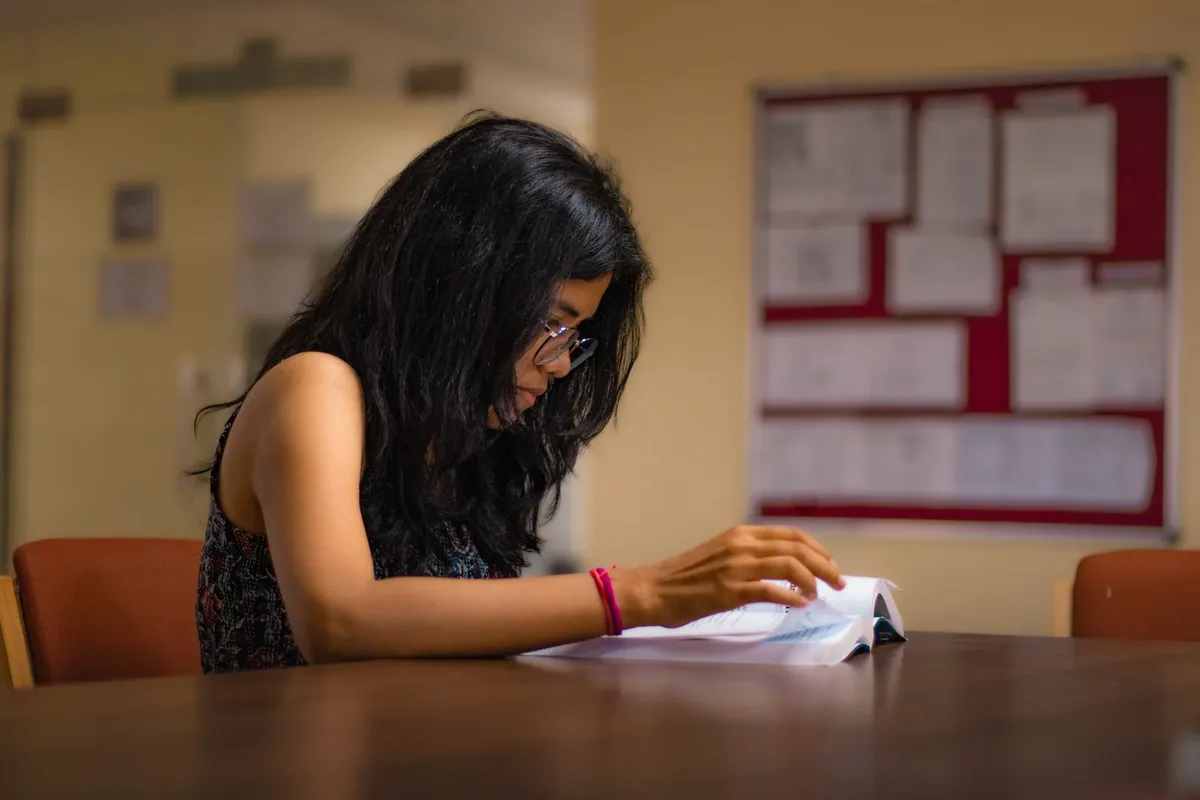
You have from today until 13 December — under three weeks. That is enough if you use it properly, and not enough if you spend the first few days just “planning”.
Phase 1 — Know the paper. Read the pattern above once more and pick your category. Then solve one full set of verbal and quantitative questions from your FSc or FA books, just to see where you stand. Most students discover their English is weaker than they thought — sentence completion and comprehension cost marks every year.
Phase 2 — Subject revision. Go back to your intermediate textbooks for the 30 subject-specific MCQs. These are FSc-level questions, not university-level. For USAT-E that means Physics, Chemistry and Maths from first and second year. For USAT-M, Biology carries 14 of the 30, so it deserves the most time. Do not buy a new guidebook for this; your own textbooks are the syllabus.
Phase 3 — Essays and timed practice. Write two essays a week, one argument-based and one narrative, in about 20 minutes each — the real paper gives you 40 minutes for both. Time yourself. The essay is These average scorers jump to 70+, because most candidates walk in without having written a single timed essay. Practise in the language you will actually use on the day, English or Urdu.
Phase 4 — Full mock and revision. Sit one full paper — 75 MCQs in 100 minutes, then two essays in 40 minutes — in one sitting, with no phone. Then revise only your weak spots. The last two days before the test are for rest and documents, not new topics.
A word about preparation material: there is no official HEC past-paper book for USAT. The weightages document above is the closest thing to an official syllabus. Anyone selling “100% original USAT past papers” is selling guesswork.
Common Mistakes That Disqualify Candidates
- Registering with someone else’s CNIC. Your father’s or brother’s CNIC will get your fee paid and your application rejected at the gate. Use your own CNIC or B-Form number.
- Picking the wrong category. The category locks after submission. Double-check it against your intermediate stream before you submit.
- Paying but never verifying. The fee alone does not complete your application. Log back in, click “Verify Online Payment”, and confirm the status says “Submitted”.
- Leaving the application in Save mode. An application that is saved but not submitted is not entertained. Submit it.
- A ported mobile number. HEC warns that numbers converted from one network to another may miss SMS alerts. Use a number that has stayed on the same network.
- Changing your mind about the test city. The city cannot be changed after registration, so choose one you can actually travel to on 13 December.
- Waiting until 24 November. The portal slows down on the last day, consumer numbers expire at the closing time, and complaints filed on the last day are not entertained. Apply in the first week if you can.
- Bringing a phone to the centre. It will be confiscated and an unfair-means case registered. Leave it at home.
USAT vs Other Entry Tests — Where It Fits
Students often ask whether USAT replaces the other tests. It does not. Here is how it sits next to the tests you will hear about:
- NUST NET is NUST’s own test, and NUST does not accept USAT in its place. If NUST is your target, you need NET.
- UET ECAT and other university-specific tests work the same way — each university sets its own requirement.
- MDCAT is the medical and dental entry test run by PMDC. USAT-M does not replace MDCAT for MBBS or BDS admission; it fits Pharm-D and allied health sciences instead.
- HEC HAT is the postgraduate test for MS, MPhil and PhD admissions and HEC scholarships. It runs on the same dates this cycle, but it is a different test for a different level.
Think of USAT as the general-purpose score: one test, many universities, plus scholarship eligibility. If you are applying to more than one university, it saves you from sitting a separate test for each.
If you are weighing your options, these guides will help: LUMS Undergraduate Admission 2027 and IBA Karachi Admission 2027 both run their own admission tests, so check their requirements separately. And
if money is the worry rather than the test, our guide on the HEC Need-Based Scholarship 2026-27 explains the financial aid that sits alongside these admissions.
1. What is the last date to apply for HEC USAT 2026?
The last date for online registration for the December 2026 sitting is Tuesday, 24 November 2026 (extended from Sunday, 22 November 2026; HEC announced the extension on 23 November 2026 and the ETC portal shows 24 November 2026). Registration is open now on the ETC portal, https://etc.hec.gov.pk. This is the fifth and last USAT sitting of 2026.
2. When is the HEC USAT test in December 2026?
The test is on Sunday, 13 December 2026. Roll number slips are issued on Friday, 4 December 2026, and the result is announced on Thursday, 31 December 2026. All dates are from HEC’s Education Testing Council Test Calendar for 2026.
3. What is the fee for the USAT test 2026?
The fee reported for the 2026 sittings is Rs 1,200, paid through 1Link / 1Bill using a consumer number generated on the ETC portal. HEC does not print the amount on its public FAQ page, so confirm the exact fee on the portal when you apply. The fee is non-refundable and non-transferable.
4. Who is eligible for USAT 2026?
Students who have passed HSSC (FSc, FA, ICS, I.Com) or an equivalent 12-year qualification, and students who have appeared in their final HSSC exams and are awaiting results. A-level students can apply too. Register with your own CNIC or, if under 18, your B-Form or Juvenile Card number.
5. What is the USAT paper pattern?
100 marks in total. Part I is 75 MCQs in 100 minutes: Verbal Reasoning 20, Quantitative Reasoning 25, and 30 subject-specific questions for your category. Part II is two essays in 40 minutes: an argument-based essay worth 15 marks and a narrative essay worth 10 marks, in English or Urdu.
6. What is the passing score for USAT?
The qualifying score is 50 out of 100 (reported). Universities set their own merit cut-offs above that, so a score of 70 or more is a much stronger position for competitive BS programmes.
7. Can I change my USAT category or test city after registration?
No. HEC’s FAQ states that the selected category cannot be changed after submission, and the test city cannot be changed after registration. Choose both carefully before you submit.
8. Where do I check my USAT result?
On the ETC portal, https://etc.hec.gov.pk, by logging in with the CNIC and password you registered with. The result for the 13 December test is announced on 31 December 2026. HEC also posts result and answer-key notices on its ETC announcements page.
Final Thoughts
The December USAT is a small window with a big payoff. Registration is open until 24 November 2026, the test is on 13 December, and the score works for BS admissions across many universities and for HEC scholarships. Register first and prepare after — the deadline will not wait for you to feel ready.
Do the same. Register first, pick the right category, verify the payment, and then spend the next few weeks preparing properly. And keep the dates somewhere you will see them: last date 24 November, slip 4 December, test 13 December, result 31 December.
For every other deadline closing this month — NUMS, Dalda, NUST NET and the rest — see our upcoming deadlines page.
Sources
- HEC Education Testing Council, Test Calendar for Year 2026 (revised 25 August 2026) — https://www.hec.gov.pk/english/services/students/etc/Pages/Test-Calendar.aspx
- HEC Education Testing Council, Content Weightages for USAT (all six categories) — https://www.hec.gov.pk/english/services/students/etc/Documents/Content%20Weightages%20for%20(USAT).pdf
- HEC Education Testing Council, Frequently Asked Questions (registration, fee payment, test-day rules) — https://www.hec.gov.pk/english/services/students/etc/Pages/FAQ’s.aspx
- HEC Education Testing Council, Announcements page — https://www.hec.gov.pk/english/services/students/etc/Pages/Announcements.aspx
- HEC ETC portal (registration) — https://etc.hec.gov.pk
Verification note
Checked 24 November 2026. The last date was extended: HEC announced on 23 November 2026 that registration for the December 2026 sitting now closes on Tuesday, 24 November 2026 (previously Sunday, 22 November 2026), and the ETC portal shows 24 November 2026 as the last date. HEC’s published Test Calendar image (revised 25 August 2026) still shows 22 November — it has not been updated yet. The other dates in this article (announcement 8 November 2026; roll number slip 4 December 2026; test 13 December 2026; result 31 December 2026) are from HEC’s own Test Calendar for 2026, read directly from the calendar image on hec.gov.pk on 21 November 2026, and the 23 November 2026 announcement confirms the test is still on 13 December 2026. The paper pattern and marks split are from HEC’s official USAT content weightages PDF. The registration steps, payment method and test-day rules are from HEC’s ETC FAQ page and the ETC portal’s registration instructions. Not confirmed on an HEC page: the exact test fee (reported as Rs 1,200 for the 2026 sittings by several current guides; one older page quotes Rs 2,000 — confirm the figure on the ETC portal before paying); the qualifying score of 50 out of 100 (reported consistently by HEC-based guides); the validity period of the USAT score (guides disagree — one year or two years — so no validity period is stated as fact in this article). The exact closing time on 24 November 2026 is not published — the portal will state it. If HEC changes any date, the ETC Test Calendar and announcements page are final.